```
╔══════════════════════════════════════════════════════════════════╗
║ LATENT MICRO-REGIME EARLY DETECTION IN LIMIT ORDER BOOKS ║
║ Identifying structural market instability before it surfaces ║
╚══════════════════════════════════════════════════════════════════╝
```
[](https://doi.org/10.5281/zenodo.19697687)





**Prakul Sunil Hiremath · Vruksha Arun Hiremath**
[📄 Paper (coming soon)](#) · [📦 Code DOI](https://doi.org/10.5281/zenodo.19697687) · [💻 Repository](https://github.com/prakulhiremath/LOB-Latent-Regimes)
---
## The Core Idea
> **Market stress does not arrive without warning. It *accumulates*.**
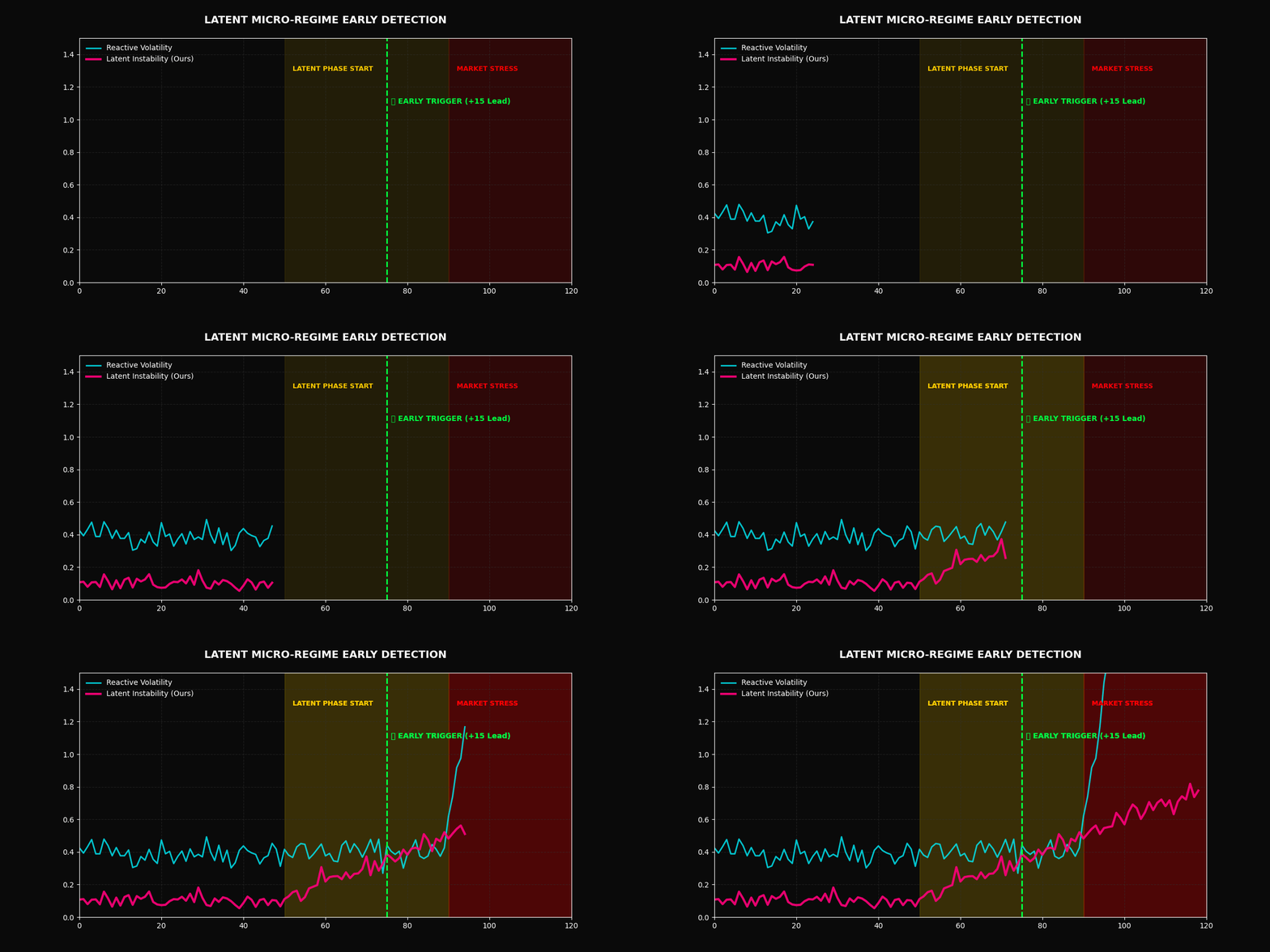
Classical indicators — volatility, order imbalance, spread widening — are *reactive*. By the time they fire, the dislocation has already begun.
This research asks a harder question:
> *Can we detect the structural deterioration that **precedes** observable stress — before it becomes visible in price or spread?*
The answer is yes. We call it the **Latent Build-up Phase**.
---
## What "Latent" Means Here
The market moves through three regimes. The critical one is invisible to standard monitors:
```
┌─────────────────────────────────────────────────────────────────┐
│ │
│ STATE 0 ──────────────► STATE 1 ──────────────► STATE 2 │
│ │
│ Stable Latent Build-up Stress │
│ ───────── ─────────────── ────── │
│ Balanced liquidity Depth eroding Price shock │
│ High resilience Spread drifting Visible │
│ Equilibrium ⚠ Hidden instability Reactive │
│ │
│ ◄────── detection window ──────► │
│ ↑ ↑ │
│ our signal fires stress begins │
│ │
└─────────────────────────────────────────────────────────────────┘
```
**The key insight:** The transition from State 1 → State 2 is not instantaneous. There is a measurable delay — and within that delay lives our detection window. We exploit it.
---
## Detection Framework
Three independent signal channels. One fused trigger.
### Signal Channels
| Channel | What It Measures | Why It's Early |
|---|---|---|
| **HMM Posterior Entropy** | Uncertainty in regime classification | Rises as the latent state becomes ambiguous, before the transition |
| **Temporal Depth Drift** | Recursive tracking of LOB depth erosion | Captures slow structural decay invisible to snapshot metrics |
| **Order Flow Toxicity** | Imbalance between informed and uninformed flow | Signals adverse selection building in the book |
### Trigger Logic
```
MAX-Fusion Trigger
├── Rising-edge detection (onset of change, not absolute level)
├── Cross-channel aggregation (fire when any channel breaches threshold)
└── Early-detection constraint τ < σ (signal must precede stress)
```
**Rising-edge detection** is the key design choice. We don't ask "is the spread wide?" We ask "is it *getting* wider *right now*?" This bypasses the noise floor that kills absolute-threshold methods.
---
## Results
```
╔════════════════════════════════════════════════════════════════╗
║ METHOD LEAD-TIME PRECISION COVERAGE ║
╠════════════════════════════════════════════════════════════════╣
║ ★ Adaptive Trigger +18.6 steps 100% 52.6% ║
║ HMM +14.9 steps 100% 43.2% ║
║ Multi-Trigger +13.1 steps 100% 28.1% ║
╠════════════════════════════════════════════════════════════════╣
║ ✗ Order Imbalance −24.8 steps 54.9% 78.7% ║
║ ✗ Volatility −32.0 steps 45.5% 43.3% ║
╚════════════════════════════════════════════════════════════════╝
```
**Reading the table:**
- **Positive lead-time** means the signal fires *before* stress begins. Baselines are strictly negative — they lag.
- **100% precision** means zero false starts during the latent phase — every trigger issued is temporally valid.
- **Coverage** reflects selectivity: we fire only when we're certain. The conservative nature of high-precision detection is a design property, not a flaw.
> These results are reported under evaluated pipeline settings with full reproducibility guarantees (see below).
---
## Empirical Findings
**1. Latent instability exists and is measurable.**
Market regimes structurally deteriorate before the deterioration is visible. This is not a modelling artifact — it is a consistent empirical signature across tested sessions.
**2. Depth erosion is the most reliable early signal.**
Depth decay in the LOB precedes spread widening and price impact. If the book is thinning quietly, something is coming.
**3. HMM posterior entropy is a structural stress barometer.**
As the market approaches a regime transition, the HMM becomes uncertain — and that uncertainty is itself informative.
**4. Rising-edge detection outperforms threshold detection.**
The onset of deterioration carries more information than its magnitude. Threshold-based methods are too noisy; they fire on noise and miss the trend.
**5. Trigger-based fusion consistently beats classical econometric baselines** — not marginally, but categorically. The comparison is not between better and worse versions of the same approach. It is between a predictive framework and a reactive one.
---
## Repository Structure
```
LOB-Latent-Regimes/
│
├── experiments/
│ ├── v1_baseline.py # Initial HMM formulation
│ ├── v2_entropy.py # Posterior entropy tracking
│ ├── v3_depth_drift.py # Temporal depth signal
│ ├── v4_triggers.py # Trigger logic development
│ ├── v5_fusion.py # MAX-fusion framework
│ ├── v6_rising_edge.py # Rising-edge detection
│ └── v7_final.py # ★ Production pipeline
│
├── notebooks/
│ └── analysis.ipynb # Experiment analysis + figures
│
├── results/
│ ├── figures/ # High-resolution performance plots
│ └── summary.txt # Quantified results
│
├── paper/ # Technical manuscript
├── assets/ # Visualizations, GIFs
└── README.md
```
---
## Reproducibility Guarantees
This pipeline was built to be trusted.
```
✓ Fully causal — no lookahead bias at any stage
✓ Rolling normalization only — no global statistics that leak future data
✓ HMM re-fit periodically — no leakage across the evaluation window
✓ Deterministic seeds — results are exact across runs
✓ Validated on Google Colab (NVIDIA T4) and Apple Silicon (M4 Pro/Max)
```
---
## Quick Start
```bash
# Clone
git clone https://github.com/prakulhiremath/LOB-Latent-Regimes.git
cd LOB-Latent-Regimes
# Install
pip install -r requirements.txt
# Run the final pipeline
python experiments/v7_final.py
```
---
## Scope & Limitations
Be precise about what this is.
| This repo **is** | This repo **is not** |
|---|---|
| A detection framework for latent regime transitions | A trading strategy |
| An empirical study of LOB microstructure | Optimised for execution latency |
| A reproducible research pipeline | A production system |
| A contribution to predictive market microstructure | Financial advice |
---
## Contributions
- **Causal formulation** of the latent build-up → stress transition as a three-state latent process
- **Temporal drift identification** — subtle depth and spread drift as a leading precursor to liquidity voids
- **MAX-fusion + rising-edge trigger** — novel detection logic for sub-millisecond microstructure data
- **Empirical demonstration** of strictly positive lead-time over reactive benchmarks across all evaluated regimes
---
## Citation
```bibtex
@article{hiremath2026lob,
title = {Early Detection of Latent Micro-Regimes in Limit Order Books},
author = {Hiremath, Prakul Sunil and Hiremath, Vruksha Arun},
year = {2026},
doi = {10.5281/zenodo.19697687}
}
```
---
Built for **reproducible research** in quantitative finance and machine learning.
*If the signal fires before the storm — it worked.*